Data · Who is filing on what, edition 2
SoftBank Group went from no AI-related U.S. patent publications to more than any other applicant
AI-related published U.S. applications by first-named applicant, the 13 weekly publication dates from July 23 to October 15, 2026, compared with the same weeks of 2025, and where SoftBank Group's applications came from.
The short version
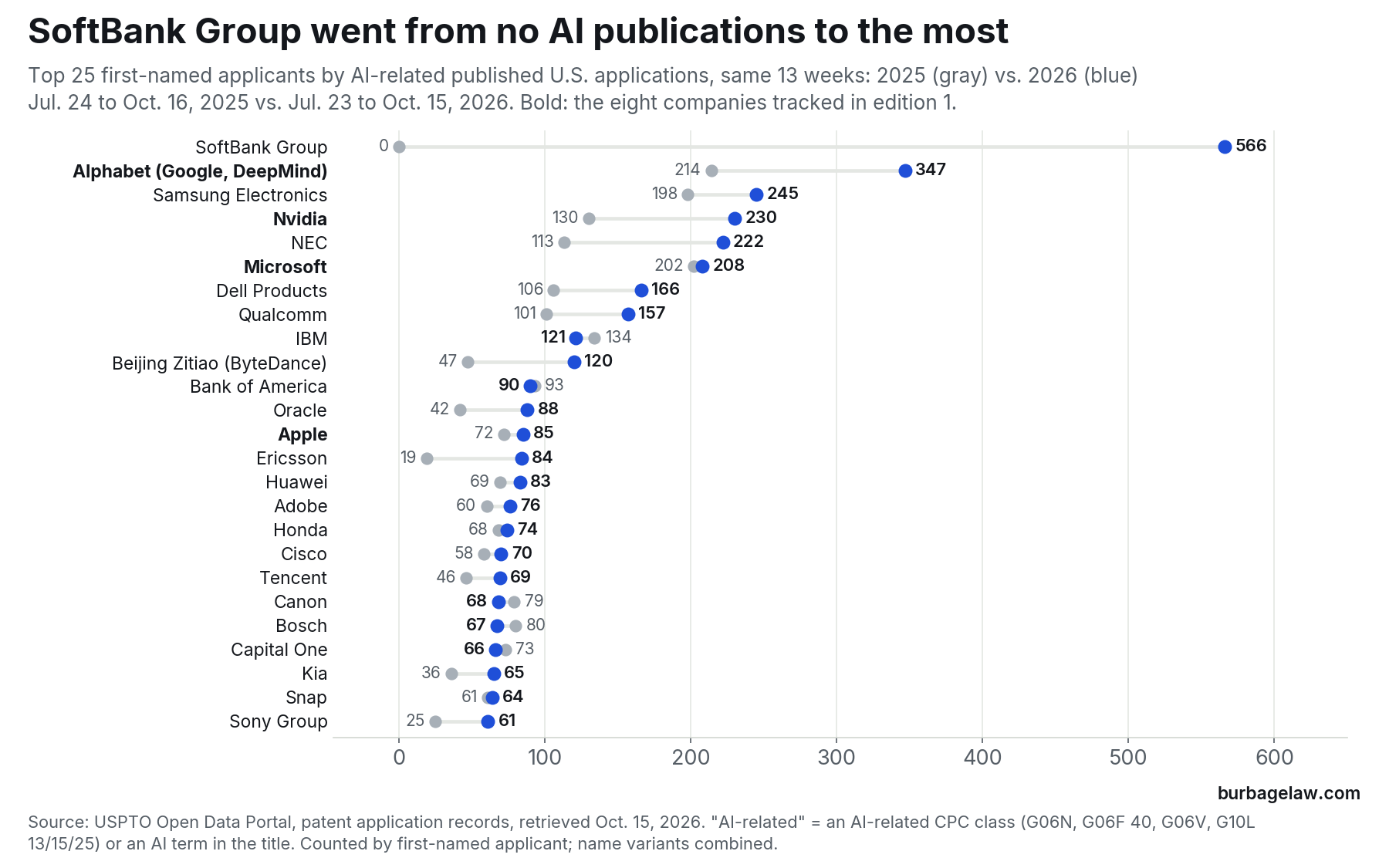
SoftBank Group Corp. was the first-named applicant on 566 AI-related U.S. patent applications published in the 13 weeks ending October 15, 2026, more than any other applicant. Alphabet was second with 347. In the same weeks of 2025, SoftBank Group published one U.S. application, and it was not AI-related.
The jump is real, and it has a plain cause. Most of the 566 are U.S. versions of applications SoftBank Group filed in Japan in February and March 2025. SoftBank Group filed them in the United States a year later, and they published together about 18 months after the Japanese filings.
Only four of the eight companies tracked in edition 1 made the top 25: Alphabet, Nvidia, Microsoft and Apple. The other 21 places went to companies such as Samsung Electronics, NEC, Dell, Qualcomm and IBM, along with banks and carmakers. The top 25 together account for 3,492 of the 12,030 AI-related publications in the window, or 29%.
Who is new and who is rising
Five applicants are in this year’s top 25 that were not in last year’s: SoftBank Group, Oracle (42 to 88), Ericsson (19 to 84), Kia (36 to 65) and Sony Group Corporation (25 to 61). Oracle and Sony Group more than doubled. So did Beijing Zitiao Network Technology, a ByteDance company, which rose from 47 to 120 and into the top 10. NEC nearly doubled, from 113 to 222.
None of the other large rises looks like SoftBank Group’s. For Oracle, Ericsson, Sony Group and Beijing Zitiao, no more than 40% of their AI-related publications in the window came in their three busiest weeks, compared with 94% for SoftBank Group. Ericsson’s rise starts from a small base of 19.
Five of the top 25 published fewer than a year earlier: IBM (134 to 121), Bank of America (93 to 90), Canon (79 to 68), Bosch (80 to 67) and Capital One (73 to 66). Toyota, Intel, Fujitsu, Maplebear and Digital Global Systems dropped out of the top 25.
Where SoftBank Group’s applications came from
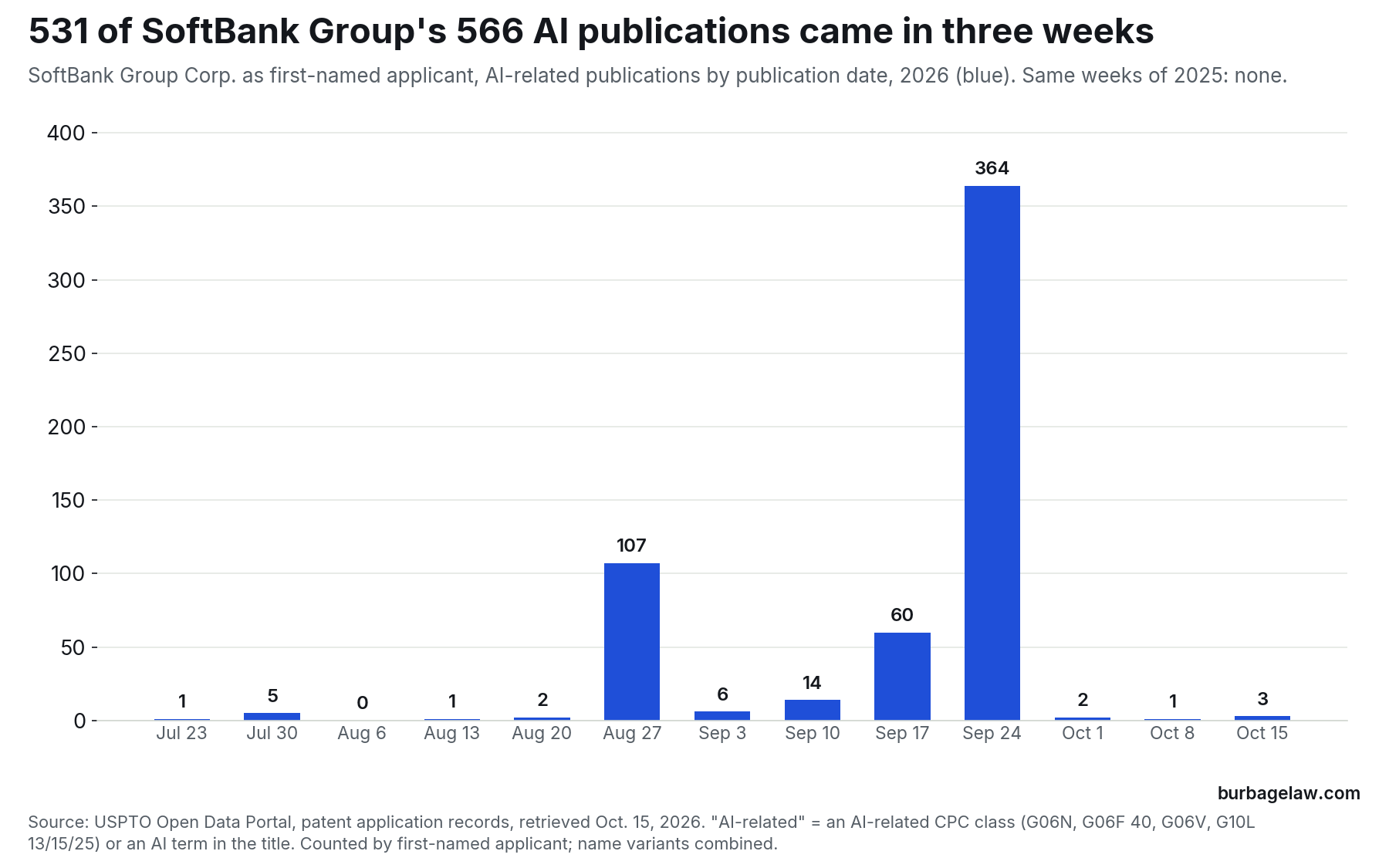
They arrived in bursts: 364 on September 24, 107 on August 27 and 60 on September 17, or 531 of the 566 in three weeks. 518 carry the one-word title “System.” G06N classifications appear on 340 of them.
The timing comes from the Japanese filings. Under the Paris Convention, an applicant that files first in Japan has 12 months to file in the United States and keep the Japanese filing date as its priority date (35 U.S.C. 119). Of the 566, 481 claim priority to a Japanese application, and 453 of those Japanese applications were filed in February or March 2025. SoftBank Group used nearly the whole year: the median gap between the Japanese and U.S. filings was 359 days, and 534 of the 566 were filed in the United States in February or March 2026. All but 17 were filed directly in the United States rather than through the international (PCT) route. Of the 84 with no foreign priority claim, 79 claim the benefit of a U.S. provisional application filed in March 2025.
The USPTO publishes an application about 18 months after its earliest priority date (35 U.S.C. 122(b)). The median here was 18.2 months, so every one of the 454 applications with a February or March 2025 priority date published between August 27 and September 24, 2026.
Xsensus LLP, a patent firm based in Vienna, Virginia, is the attorney of record on 506 of the 566: its address is the correspondence address and the address in the power of attorney. Other firms appear as the correspondence address on the rest, among them Morgan, Lewis & Bockius on 23, SOEI USA on 19 and Banner & Witcoff on 11.
The U.S. filings are a small part of a larger program. In Japan, SoftBank Group was the first-named applicant on 10,400 published applications in 2025 and 22,848 so far in 2026, more than any other applicant, according to the IP Force patent rankings. A report on WIPO’s generative AI patent data ranks SoftBank Group first in the world in that field and says the company has run a generative AI idea competition open to all group employees since 2023, filing patent applications on the best ideas. The U.S. records fit that account: the 566 name 463 different inventors, and Masayoshi Son is named on 25.
Without SoftBank Group, AI-related publications rose 31%, from 8,740 to 11,464. With it, they rose 38%, to 12,030.
What it means for in-house counsel
Watch lists built on last year’s leaders are out of date. If they work in your space, add SoftBank Group, Oracle, Ericsson and Beijing Zitiao to competitor monitoring, and search affiliates’ names as well as the parent’s.
Title searches will not find most of SoftBank Group’s work, because 518 of these applications are titled “System.” Screen by classification and read the claims.
Date these references correctly. A published application is prior art as of its effective filing date (35 U.S.C. 102(a)(2)), and for subject matter described in a foreign priority application that is the foreign filing date (35 U.S.C. 102(d)). For most of these, that is February or March 2025, not 2026. If you filed an AI application after early 2025, several hundred newly published references from one applicant may bear on it. Update the novelty search before the first Office action, and disclose anything material.
Expect more. SoftBank Group publishes far more applications in Japan than it has brought to the United States, and any Japanese application it carries over within 12 months of filing will appear here about 18 months after the Japanese date.
Method
Data: USPTO Open Data Portal, patent application records, retrieved October 15, 2026. The windows are the 13 weekly publication dates from July 23 to October 15, 2026, and from July 24 to October 16, 2025.
Every published utility application in each window carrying a CPC code in G06N, G06F 40, G06V, or G10L 13, 15 or 25, or an AI term in its title, was retrieved and classified with the edition 1 rule: a publication counts as AI-related if it carries one of those CPC codes or its title uses a term such as “machine learning,” “neural network,” “language model” or “generative.” That gave 8,740 AI-related publications in the 2025 window and 12,030 in the 2026 window.
Applicants are counted by first-named applicant only. Spelling, capitalization, punctuation and corporate-suffix variants of the same name are combined. The eight companies from edition 1 are grouped as they were there; Alphabet includes Google LLC, GDM Holding LLC and DeepMind Technologies Limited. Other affiliates are counted separately: Sony Group Corporation apart from Sony Interactive Entertainment, Beijing Zitiao Network Technology apart from ByteDance Inc., and SoftBank Group Corp. apart from SoftBank Corp. The records list no first-named applicant for 292 AI-related publications in 2025 and 559 in 2026; those are not attributed to anyone.
Priority claims, continuity data, national-stage status, inventors and attorneys of record for SoftBank Group’s 566 applications come from the same USPTO records, retrieved October 16, 2026. “Attorney of record” means the firm named in both the correspondence address and the power of attorney. One application recorded with a Chinese priority claim has a Japanese-style number and filing date; it is counted as recorded. The burst comparison for Oracle, Ericsson, Sony Group and Beijing Zitiao uses records retrieved the same day. Japanese publication counts are from IP Force, which counts applications by first-named applicant. The employee idea competition is as reported from WIPO’s data and was not independently confirmed.
Ericsson’s 19 publications in the 2025 window is a small count, so its rate of growth is not meaningful.
Revised October 16, 2026: added where SoftBank Group’s applications came from, the firm of record, and the comparison with other large rises, and corrected the advice to in-house counsel, which had dated these applications from their 2026 U.S. filings rather than their 2025 Japanese priority dates.
Source: USPTO Open Data Portal · IP Force, SoftBank Group Corp. applicant ranking (Japanese) · 36Kr, report on WIPO generative AI patent data
← All data editions · Developments
Burbage Law is the practice of Jon Burbage, a registered patent attorney. 342 United States patents have issued from applications he wrote; the full list is on the Patents page. More about Jon Burbage.
These figures are computed from public USPTO records as described above. They are general information, not legal advice, and do not create an attorney-client relationship.